

This is a reader-supported site. When you buy through links on this site, I may earn an affiliate commission. Thanks for your support! 🙂
The Toad Sculpture Update: A Year in the Elements
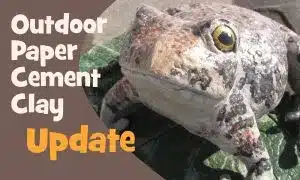
It’s time for another update on the Toad made with paper cement clay. Just over a year ago, I introduced you to this recipe for an outdoor version of paper mache, which I borrowed from a guest post written by Warren Eggleton. I made a few tweaks to Warren’s recipe and used it to create the Toad sculpture.

So – how did he do out in the wild?
Our last Minnesota winter included freezing temperatures as low as -30° F, heavy rain, and at least three feet of snow. (It’s a long trip to the chicken coop when you’re shoveling that much snow!)
After spending the cold winter and a hot summer with some very heavy downpours, Mr. Toad still has bright colors, and there are no cracks or other damage – he’s doing fine. 🙂
But some people didn’t have the same luck I did…
Many of you decided to start on your own paper cement clay experiments, and it’s been fun seeing all the posts about the paper cement clay that have been showing up on the Daily Sculptors page.
But we recently received a post from Michele, who shared her lizard sculpture. It looked fantastic when she finished it last year, but a few weeks ago she noticed small white spots all over it.
While I’m no cement expert, I suspect this might be due to the different sealers that we used. But if you have a better explanation, please let us know.
How I sealed my toad
I used Rust-Oleum Matte Clear Enamel on mine. I’m using it on some of my indoor sculptures now, too, because I really like the matte finish. It did work for my toad – but I don’t know if that’s the “best” sealer for cement sculptures. I can’t afford to buy every product and test it myself.
However, I do know that sealing your outdoor sculptures is really important if you plan to leave them out in the rain and snow.

The paint I used for the toad
Someone recently asked me what paint I used for my sculpture. I kept it simple and used regular acrylic artist paint.
Toad feet. 🙂
Someone recently asked if I put the paper cement clay over the epoxy clay that I used for Mr. Toad’s feet. The answer to that is ‘no.” I used the Magic Sculpt because it was too hard for me to get the paper cement clay to look nice over the wire – I have the same problem with paper mache clay. So I used the epoxy clay instead. That means that I couldn’t test how the cement clay would fare on those delicate toes. If you give it a try, let us know the results!
I forgot to mention it in the video, but Rosita sent in a post a few days ago, and showed us a frog that was cast with the paper cement clay – there was no wire in her frog’s toes, and they broke. You can see her post here.
How long did I cure the paper cement clay toad?
With concrete, you’d want it to cure slowly over a month or more. And yes, I know this isn’t really concrete, but a lot of concrete experts have mentioned this, especially in the YouTube comments.
But I admit I didn’t follow that rule. I let the Toad dry for about three to four days before painting and sealing him. I got away with it, but you might want to stick with the experts’ advice, instead. Maybe I just got lucky. 🙂
Why I really liked working with the recipe:
I really liked the way the paper cement clay felt when I was spreading it over the toad’s foil armature – I think I even like it more than the original paper mache clay recipe.
As soon as I get the front yard looking like somebody actually lives here, I hope to start making a lot more outdoor sculptures. But I actually had to bring Mr. Toad inside a few weeks ago, because he was getting lost in the weeds. I’ve been having way too much fun making mask and sculpture patterns, and that’s my excuse for not taking better care of my yard. (I redesigned the image that goes at the top of that page yesterday – if you have a chance to take a look at it, let me know what you think. 🙂 )
The perpetual drywall joint compound problem has just gotten worse…
There’s now another brand of drywall joint compound that we can’t use in any recipe that also includes the Elmer’s Glue-All (PVA) glue. We now know that you can’t use either DAP or Wurth in paper mache clay, the smooth air dry clay, or the paper cement clay recipe.
So you might want to use the paper cement clay recipe that doesn’t use any joint compound, even if you’ll be leaving your sculptures inside. I think I may start doing that myself. The no-joint compound recipe is on this page – just scroll down a bit to find it.

I hope you’ll share your own paper cement clay experiences. Head over to the Daily Sculptors page and post your creations. Let us know what materials you used and how they held up in the elements. The world of sculpting is full of discoveries, and together, we can keep pushing the boundaries of what’s possible.
To see the posts that other people have already submitted, put “paper cement clay” in the search bar.
And one last thing – would you like me to send out a newsletter one a week, instead of the rather casual way I’ve been doing it, whenever I have a project or post to tell you about? Let me know if the comment section below. 🙂

I like your videos, but a news letter would be nice to read as well. Thanks
James Jackson
Mississippi Christian U
I have a newsletter, but I haven’t posted much in the last few months because I moved, and I’m in the process of remodeling an old mobile home. Still no studio in the new place, and it’s really slowing me down. But be sure to subscribe so you’ll get the next one I put out. 🙂
If I’m not mistaken joint compound is basically calcium carbonate (limestone powder/marble dust) with a little binder (PVA or acrylic). One can get marble dust from artists suppliers like Kremer pigments. Sadly its expensive compared to joint compound. The offending ingredient in joint compound is probably borax which is used as a preservative. Borate will cross link Elmers glue into a glob.
I agree – there are YouTube videos about making slime for kids out of Elmer’s and borax, so that’s probably why a lot of joint compound brands won’t work in this recipe. I do have a recipe for the indoor paper mache clay/air dry clay that uses powdered marble instead of joint compound, and it works really well. The artists’ version of calcium carbonate is, as you mentioned, really expensive. But if you want to make a whole lot of sculptures, you can get it as a very fine powder in a very large bag from Azure Standard. A 50# bag would last a very long time! But if you have a group that likes to make stuff together, it might be worth getting a bag and splitting it between members.
I compost everything that can be composed for my food garden (I only garden organically). I save my organic eggshells, clean, bake then throw them in the blender to make a fine powder that is more quickly absorbed by plants. My question is; since eggshells are 95% calcium carbonate, would they work in place of the joint compound?
I have never tried it. I do have a video about making paper mache clay with calcium carbonate. It was very finely ground. The kind you get at a garden store isn’t fine enough, so it won’t work. You might want to watch that video, and then experiment with this paper cement recipe with your egg shells, and see what happens. Be sure to let us know what you find out! 🙂
Dearest Jonni, you boost my spirits and I am sure that there are many others out here who agree. Yes please! I agree with others who don’t want to increase your work load.
I am an example of inertia. An object in motion tends to stay in motion and an object standing still tends to remain standing still. I really need to turn on my switch ! , Kay
I can definitely relate! I haven’t been able to make anything for several weeks because my basement flooded again, and I had to get stuff out so contractors could keep the water out. Lots of trips up and down the stairs, but no fun projects. They’ll be done with it today, and I hope I can get my creative spirit working again!
You might like to start with a little project, just to get you started. I’ve noticed that bigger projects take longer to start, and they’re easier to put down without finishing them. 🙂